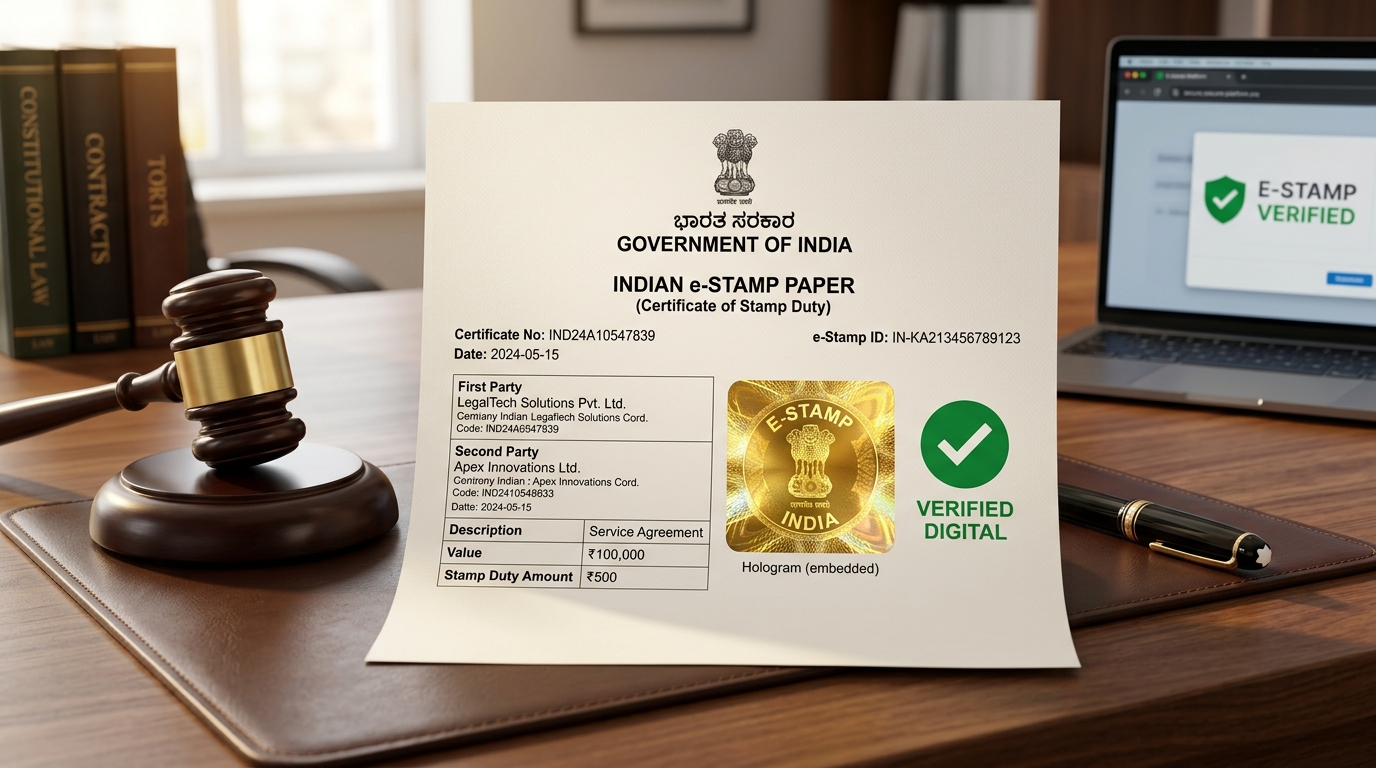
In India, paying stamp duty to state governments has historically been a tedious, paper-intensive bureaucratic task. Following widespread security concerns and counterfeiting scandals in the early 2000s, state governments partnered with the Stock Holding Corporation of India Limited (SHCIL) to launch e-Stamping—a digitally backed, tamper-proof system designed to collect non-judicial stamp duty with complete transparency.
What is e-Stamp Paper and How Does it Function?
An e-Stamp paper is a computer-generated, tamper-proof certificate of stamp duty payment issued by an authorized Central Record Keeping Agency (CRA). Unlike traditional physical non-judicial stamp paper, which can be forged or backdated, an e-Stamp certificate contains an unalterable 19-digit alphanumeric Unique Identification Number (UIN), a 2D matrix barcode, and digital verification signatures.
Legal Precedent: The Supreme Court of India in Thiruvengada Pillai v. Navaneethammal (2008) clarified that stamp papers do not carry an expiration date. However, Section 54 of the Indian Stamp Act, 1899 stipulates that unexecuted stamp papers can be submitted for an official refund within 6 months from the date of purchase.
Key Security Features of an Official e-Stamp Certificate
- 19-Digit Unique Identification Number (UIN): A cryptographically secured certificate serial number tracked on the central government repository.
- Encrypted 2D Barcode: Instantly scannable using any smartphone camera to pull verified certificate metadata directly from state registries.
- Immutable Party Names & Consideration Value: The First Party (purchaser/landlord/deponent) and Second Party (tenant/counterparty) are permanently printed.
- Government Watermark & Hologram: Specialized optical tamper-evident background patterns prevent color photocopying or unauthorized reproduction.
- Specific State Schedule Tagging: Certificates are state-locked and cannot be cross-utilized in other state jurisdictions without supplemental adjudication.
Step-by-Step: How to Verify Any e-Stamp Certificate Online
Any party to a transaction, bank official, or registrar can independently verify the authenticity of an e-stamp certificate in under 30 seconds using these straightforward steps:
- Locate UIN: Find the 19-digit Certificate Number printed at the top right of the certificate.
- Access Portal: Visit the official CRA verification portal or use Easy eStamp's verification portal.
- Select State: Choose the issuing state (Delhi, Karnataka, Maharashtra, etc.).
- Submit Credentials: Input the certificate number, issue date, and security captcha.
- Verify Record: Cross-check that the displayed purchaser name, consideration value, and stamp duty match your physical document.
State-Wise e-Stamping Adoption Across India
Today, e-Stamping is fully operational across major Indian states including Delhi NCT, Karnataka, Maharashtra, Uttar Pradesh, Tamil Nadu, Gujarat, Punjab, Himachal Pradesh, and Rajasthan. While states like Delhi have achieved 100% mandatory e-stamping with physical stamps phased out, other states offer a hybrid approach where both e-stamps and franked papers are accepted.